Features
Foggy Coastal Nights: Smart Yard Lighting Settings That Actually Work
Adjustable smart lighting settings for foggy coastal nights: beam angles, color temperature, dimming schedules, motion triggers, and salt-air upkeep.
What to take away
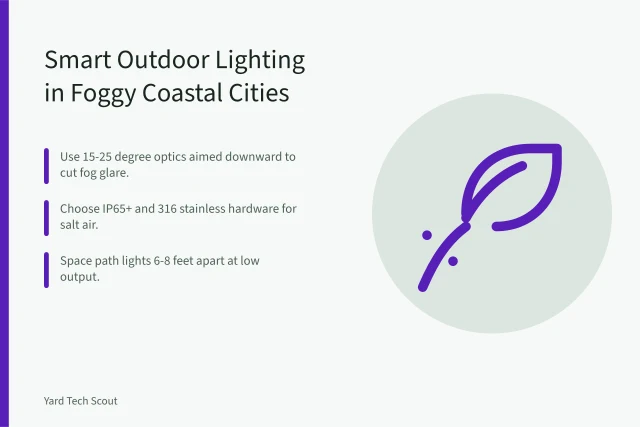
- In fog, narrow beams beat brighter beams. Start with 10 to 15 degree optics for paths and steps.
- Set color temperature to 2700K or 3000K. Blue-rich light at 4000K and above scatters more.
- Run scenes from a twilight offset plus motion, and dim to 25 to 30 percent after 10 pm.
- Choose IP65 or better with a sealed driver, and clean salt film off lenses monthly.
Why fog rewrites your lighting settings
Fog is a cloud of tiny water droplets sitting at eye level. Light hitting those droplets scatters back toward the viewer, and that returning light reads as glare. Adding lumens makes the veil worse, not better. Narrow beams and lower output usually show the path more clearly.
Coastal fog carries salt as well. Salt film builds on lenses, cuts output, and pits anodized aluminum over time. A fixture rated for rain may still fail on a beach block.
Atlantic coast gardens need their own measurement routine. The Halifax and St. John's field test gives you a repeatable three week method for lens fogging, salt film, and sensor drift.
Dark sky rules also shape output. Many coastal towns cap lumens and require shields, and the National Park Service night skies program lays out the ecological and regulatory reasoning behind those limits.
Beam angle and color temperature settings
Backscatter grows with beam width. A tight optic concentrates light on the surface you care about and leaves less airborne moisture lit up. The table below is a starting point you can adjust by eye on a foggy night.
Beam Angle vs Fog Behavior
10-15 deg
- Fog behavior
- Tight cone
- Where to use
- Paths, steps
- Color temp
- 2700-3000K
- Dim floor
- 25 percent
25-35 deg
- Fog behavior
- Noticeable glow
- Where to use
- Wall wash, shrubs
- Color temp
- 2700-3000K
- Dim floor
- 25 percent
60 deg and up
- Fog behavior
- Heavy veiling glare
- Where to use
- Avoid on fog nights
- Color temp
- 2700-3000K
- Dim floor
- 25 percent
Fog behavior
- 10 to 15 degrees
- Tight cone, minimal backscatter
- 25 to 35 degrees
- Noticeable glow, still usable
- 60 degrees and up
- Heavy veiling glare
Where to use it
- 10 to 15 degrees
- Paths, steps, driveway edges
- 25 to 35 degrees
- Wall wash, low shrub uplight
- 60 degrees and up
- Avoid on fog nights
Color temperature matters just as much. Warm white between 2700K and 3000K creates a softer veil than cool white. If your fixtures are tunable, schedule the warm end for evening and keep cooler settings for daytime accents you rarely use.
Two more settings matter. Keep the dim floor at 25 percent so path cameras still see detail. Aim fixtures down 15 to 20 degrees below horizontal to keep light out of the fog layer and out of neighbors' windows.
Example: a fog night lighting schedule
Here is a schedule that holds up when the marine layer rolls in.
Fog Night Lighting Schedule
- 15-20 min before sunsetStart lighting
- First 90 minutesHold full output
- After 10 pmDim to 25-30 percent
- Motion triggerFull brightness 60-90 sec
- MidnightAccent circuit off
A fog night lighting schedule
- Start 15 to 20 minutes before sunset instead of at a fixed clock time.
- Hold full output for about 90 minutes while people arrive home and walk the dog.
- Dim to 25 to 30 percent after 10 pm so backscatter and sky glow both drop.
- Trigger motion scenes at full brightness for 60 to 90 seconds, then return to the dim level.
- Turn the accent circuit off at midnight if your town has a curfew ordinance.
Controller and sensor settings
Copy this checklist into most smart lighting apps:
- Beam angle at 10 to 15 degrees for paths, 25 degrees for walls
- Color temperature locked at 2700K to 3000K for evening scenes
- Dimming floor at 25 percent so cameras and paths stay usable
- Motion hold time of 60 to 90 seconds
- Sunrise auto-off enabled as a backup to the schedule
Most apps hide these choices under scene settings. Save the fog profile as its own scene so you can switch back on a clear week without rebuilding the schedule.
Placement, salt, and rain
Mount heads low and aim them down. A fixture at knee height throws less light into the fog layer than one at eave height. Keep beams off reflective surfaces like wet pavers, which bounce light back into the mist.
Marine layer fog and salt spray change placement, IP ratings, and corrosion protection, and the US coastal buyers guide walks through those choices for American yards.
If you want a compact reference on IP ratings, beam angles, color temperature, and controls, the coastal cities buying primer covers the same ground in less space.
Seattle and Portland face drizzle rather than Atlantic fog, and the Pacific Northwest rain guide explains how that shifts drainage, dark sky rules, and control choices.
Broad beams also spill light upward. Light pollution is a documented effect of poorly aimed outdoor lighting, and the same principles sit behind dark sky rules for residential yards.
Outdoor transformers fall under the National Electrical Code, and the NFPA codes and standards portal is the source for those requirements. Ask a licensed electrician to confirm transformer sizing and grounding before you add circuits.