Industry
Part of Getting outdoor lighting controls right the first time, updated for 2027
How outdoor lighting jobs get scoped, priced, and handed over
How outdoor lighting work is scoped and priced: line versus low voltage, trench coordination with irrigation and drainage, and what a proper handover contains.
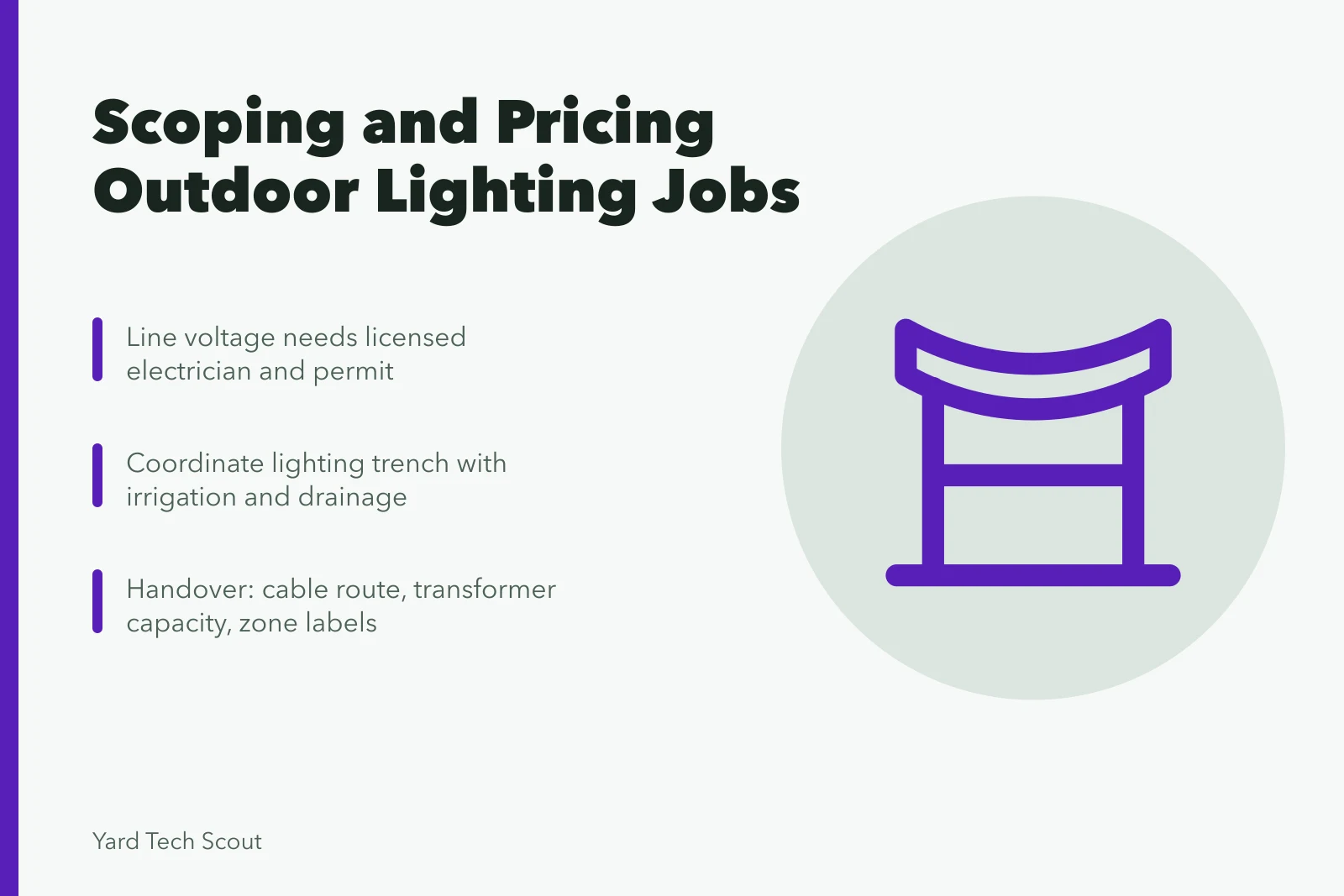
Outdoor lighting sits across two trades. The line-voltage supply, the outdoor circuit, and anything inside a panel belong to a licensed electrician in most jurisdictions. The low-voltage side, transformers, cable runs, and fixtures, is frequently installed by a landscaping firm or by the owner. Understanding that split is what makes a quote comparable and a schedule realistic.
What to take away
- Establish where line voltage ends and low voltage begins, because that boundary decides who does what.
- Coordinate lighting trenches with irrigation and drainage work, or pay for the same trench twice.
- Cable route and transformer position drive cost more than fixture count does.
- Ask for the same handover you would expect from any other buried system.
The split, and why it matters for the quote
| Work | Usually who | Usually needs |
|---|---|---|
| New outdoor circuit or panel work | Licensed electrician | Permit and inspection |
| Weatherproof outlet or transformer feed | Licensed electrician | Permit and inspection in most US towns |
| Low-voltage cable and fixtures | Lighting or grounds maintenance firm | No permit in many US towns; NEC Article 411 applies at 30 volts or less |
| Controller and scheduling setup | Either, or the owner | None |
| Trenching across paving | Whoever holds the excavation scope | Locate request, sleeving |
A quote that does not say which side of that line it covers is not a quote you can compare.
Who Does Which Lighting Work
Work type
- New outdoor circuit or panel
- Licensed electrician
- Weatherproof outlet or transformer
- Licensed electrician
- Low-voltage cable and fixtures
- Lighting or grounds firm
- Controller and scheduling setup
- Either, or the owner
- Trenching across paving
- Excavation scope holder
Usually who
- New outdoor circuit or panel
- Permit and inspection
- Weatherproof outlet or transformer
- Permit in many places
- Low-voltage cable and fixtures
- Local rules vary
- Controller and scheduling setup
- None
- Trenching across paving
- Locate request, sleeving
Usually needs
- New outdoor circuit or panel
- Weatherproof outlet or transformer
- Low-voltage cable and fixtures
- Controller and scheduling setup
- Trenching across paving
Two things drive price: trench length and how much work the panel needs. A long run under a paved drive costs more than four fixtures on a run that is already going in.
On a typical US residential job the low-voltage side, fixtures, cable, and transformer, carries about 55 to 70 percent of the invoice. The line-voltage feed, trenching, and controls carry the rest.
Trenching is usually priced per linear foot. The rate climbs with what the machine has to cut through. Treat the split as a test on a quote, not as a standard.
How a job gets scoped
Site visit. Walk the property at dusk. Note existing light, tree cover, walkway routes, and where the panel sits. Spare breaker space decides whether the line-voltage feed is a small job or a panel upgrade.
Fixture count. Count fixtures by zone from the plan, then add the ones the owner expects to add later.
Load calculation. Multiply fixture watts by the count in each zone. Modern LED fixtures are typically 3 to 12 watts each, so a 12-fixture zone often lands under 100 watts.
Transformer sizing. Size the transformer above the connected load, with 20 to 30 percent headroom, and keep the load within 80 percent of the transformer rating.
A comparable quote itemizes fixture count, transformer size and spare capacity, trench length and surface, who pulls the line-voltage feed, and the handover items below.
Coordinate the trench, not just the cable
The cheapest lighting cable is the one laid in a trench somebody was already digging. EPA's archived summary of green infrastructure benefits lists rain gardens, tree plantings, and permeable paving as features that soak up rainfall, so route the trench around them and record where you went.
Where lighting and irrigation share one trench, local practice sets the separation.
Crews, vegetation, and a practical safety note
EPA's advice on preventing tick bites recommends cutting back tall grass and leaf litter, and checking for ticks after work in shrubs.
What to ask for at handover
A cable route plan earns the name only if it carries numbers. Ask for a sketch of the property with each run drawn on it, cover depth marked for every segment, and sleeves noted where cable passes under paving, a driveway, or a footing.
The zone map ties each run to the labels at the transformer, so a fault in zone three can be found without opening the yard.
Typical US minimum cover from NEC Table 300.5: 6 in for low-voltage lighting cable and 24 in for direct-buried line-voltage cable.
- A cable route plan with depths and any sleeving marked.
- Transformer location, capacity, and how much spare capacity remains.
- Circuit and zone labeling that matches the plan.
- The schedule as configured, including the location settings for astronomic control.
- Model numbers, lamp types, and where spares come from.
Compare how other outdoor trades organize themselves in our note on how local installers work, and choose the control method first using our comparison of lighting controls.