Features
Smart Outdoor Lighting in Foggy Coastal Cities: What US Buyers Should Know
Coastal fog, salt air, and humidity shape smart outdoor lighting choices. Learn IP ratings, beam angles, color temperatures, and controls for US coastal yards.
Smart Outdoor Lighting in Foggy Coastal Cities: What US Buyers Should Know
What to take away
- For smart outdoor lighting in foggy coastal cities, shielded fixtures with 15 to 60 degree beams aimed down cut glare.
- Warm color temperatures from 2700K to 3000K improve smart lighting visibility in fog compared with 4000K or cooler light.
- Salt air and humidity demand at least IP65, with IP66 or IP67 for exposed fixtures and marine-grade hardware.
- Smart controls help most when they dim after 10 p.m. and use motion for path lights instead of constant uplighting.
How Salt Air and Fog Change Fixture Choices
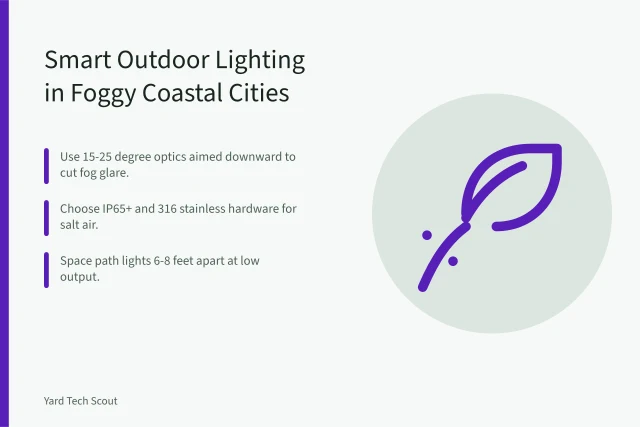
Salt air corrodes aluminum and steel, especially at the coast. Fog adds moisture that reaches connections and drivers. Buyers in Astoria, Oregon or Bar Harbor, Maine should look for die-cast aluminum with powder coat, 316 stainless steel screws, and gasketed housings. Fixtures rated IP65 resist dust and water jets. Exposed posts need IP66 or IP67.
Great Lakes shorelines bring freeze-thaw cycles, while Pacific Northwest coasts bring long damp seasons. Maine adds salt spray and strong storms. Each condition stresses gaskets, screws, and drivers in different ways. Coastal fog smart lighting planning starts with those local patterns.
Beam Angle and Color Temperature in Coastal Fog
Fog is made of tiny water droplets. Light hits those droplets and scatters back toward the eye. A wide 120 degree flood makes a bright wall of glare. Narrow beams of 15 to 30 degrees for uplights and 60 degrees for path lights keep light on the ground.
Warm white at 2700K to 3000K cuts glare. Cool 4000K light scatters more and looks harsher in mist. The National Park Service night skies program explains why shielded, downward light also protects wildlife and night views.
Fog density changes by place. San Francisco fog is well known, but Astoria and Bar Harbor can see days of mist. Use lower output and fewer fixtures when fog is thick.
IP Ratings and Corrosion Resistance for Coastal Yards
IP Ratings and Corrosion Resistance
| Exposure | Minimum IP rating | Housing and hardware | Beam and color |
|---|---|---|---|
| Covered porch or soffit | IP44 | Powder-coated aluminum | 60 degree, 2700K |
| Open path or garden bed | IP65 | Die-cast aluminum, 316 stainless screws | 60 degree, 3000K |
| Exposed post or dock | IP66 or IP67 | Marine-grade 316 stainless or composite | 30 degree, 2700K |
| In-grade or near sprinklers | IP67 or IP68 | Sealed driver, silicone gaskets | 15 to 30 degree, 2700K |
Salt fog testing, such as ASTM B117, is a useful label for coastal fixtures. Many consumer smart lights skip that test. Check the driver and connector. A sealed driver lasts longer than an open one. Replace rubber gaskets every few years if they harden.
- Look for IP65 or higher on the fixture label.
- Confirm 316 stainless screws or marine-grade composite.
- Check that the driver is sealed and replaceable.
- Ask for ASTM B117 salt fog test results.
Smart Controls and Scheduling for Foggy Evenings
Smart lighting apps from Lutron, Philips Hue, Ring, and Govee let you set schedules, dim levels, and motion triggers. In fog, a motion sensor that turns on full brightness can create glare. Set path lights to 20 to 30 percent after sunset. Use warm white and a slow ramp.
A hub with Matter support can link fixtures without cloud delays. Local schedules keep working when Wi-Fi drops. A smart plug from Lutron or a Hue outdoor power supply can control older fixtures. That option helps renters or HOA members who cannot replace hardwired posts.
Example: A Pacific Northwest Path Lighting Plan
A homeowner in Seattle or Portland can follow this plan. Use a low-voltage transformer sized above the total wattage. The National Electrical Code, published by NFPA sets transformer and wiring rules that installers must follow. Outdoor transformers must also meet OSHA electrical safety rules for disconnects and wiring methods.
Pacific Northwest Path Lighting Plan
- Mark the foggiest hours. In Pacific Northwest coastal towns, fog often sits from late evening to mid morning.
- Pick shielded path lights with 60 degree beams and 2700K to 3000K bulbs.
- Aim uplights at 15 to 30 degrees and keep them off walls that face the street.
- Set motion zones for walkways, not for the whole yard.
- Mount the transformer above grade and inside a gasketed enclosure.
Where Canadian Coastal Testing Fits
Atlantic Canada adds freeze-thaw, salt spray, and sea ice. The Halifax and St. John's field test tracks how those conditions decide which fixtures, IP ratings, and controls survive. US buyers in Maine or the Great Lakes can read it as a colder, wetter stress test. For Canadian climate data, Environment and Climate Change Canada weather tools list freeze and frost dates.