Reviews
Getting outdoor lighting controls right the first time, updated for 2027
How outdoor lighting controls differ in 2027: timers, photocells, motion and scheduling, plus the siting questions about insects, wildlife and neighbors.
We do not test fixtures, so this compares control methods, not products. The control method sets when light appears, how long it stays, and whether it reacts to anything.
That matters more than lumen figures for two reasons: it is where the running cost sits, and it decides how much light spills into places you did not intend to light.
What to take away
- Four control methods cover almost everythingfixed timer, photocell, astronomic scheduling, and motion or presence.
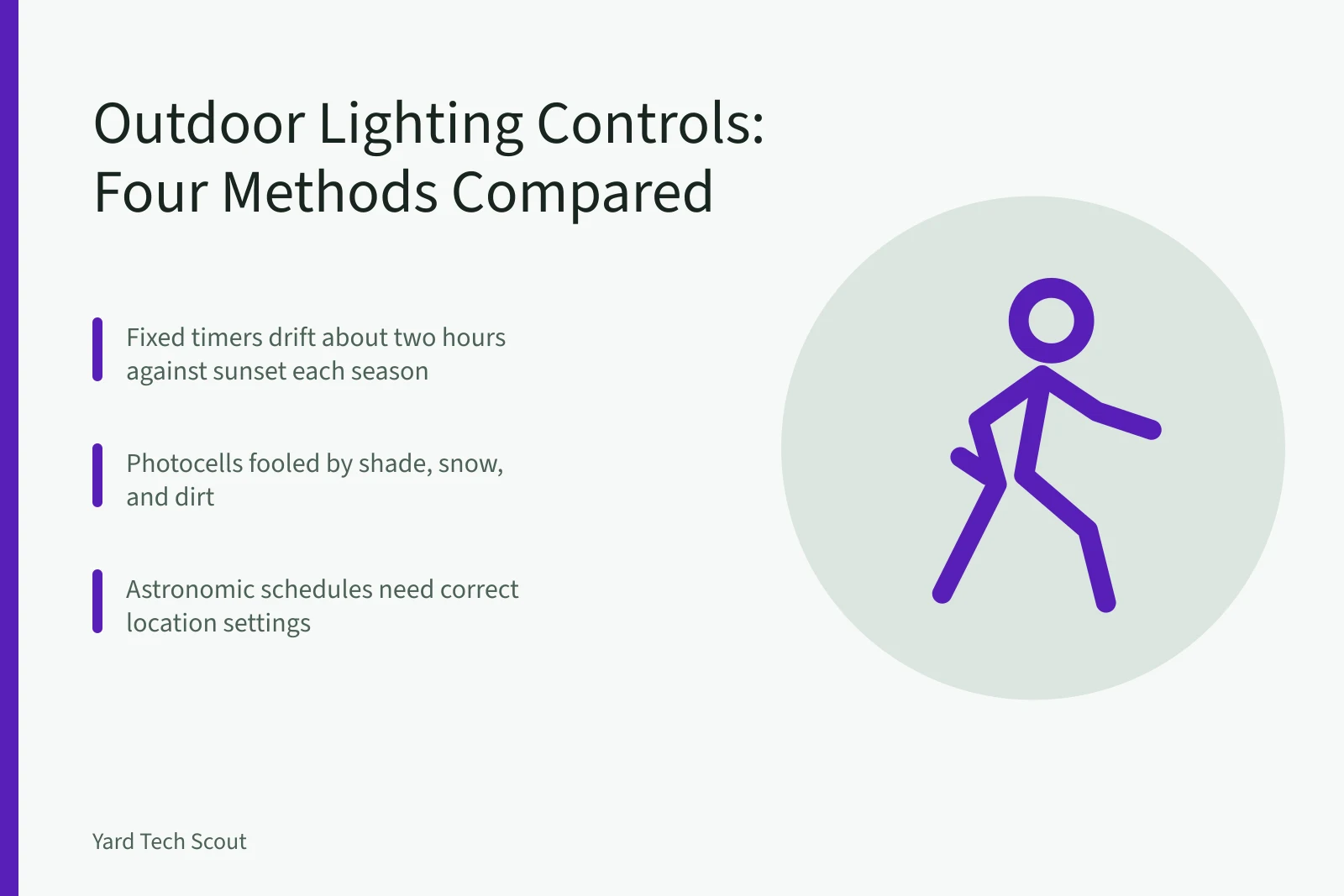
- Fixed clock timers drift out of step with sunset by roughly two hours across a season.
- Lighting extends outdoor use into the hours when biting insects are most active, so plan for that rather than being surprised by it.
- Light falling on planting and boundaries is a design decision, whether or not anybody made it deliberately.
The four control methods
How it decides
- Fixed timer
- Clock only
- Photocell
- Measured light level
- Astronomic schedule
- Date, location, sunrise and sunset
- Motion or presence
- Detected movement
Best for
- Fixed timer
- Simple, low-cost installs
- Photocell
- Dusk-to-dawn security
- Astronomic schedule
- Path and feature lighting
- Motion or presence
- Access points, steps, gates
Weakness
- Fixed timer
- Drifts against sunset all season
- Photocell
- Fooled by shade, snow, and dirt
- Astronomic schedule
- Needs correct location settings
- Motion or presence
- False triggers from animals and traffic
Most good installations mix them: astronomic scheduling for the base layer, motion for entrances, and a manual override that anybody in the household can find in the dark.
Four Outdoor Lighting Control Methods
Fixed timer
- How it decides
- Clock only
- Best for
- Simple, low-cost installs
- Weakness
- Drifts against sunset
Photocell
- How it decides
- Measured light level
- Best for
- Dusk-to-dawn security
- Weakness
- Fooled by shade, snow, dirt
Astronomic schedule
- How it decides
- Date, location, sunrise/sunset
- Best for
- Path and feature lighting
- Weakness
- Needs correct location settings
Motion or presence
- How it decides
- Detected movement
- Best for
- Access points, steps, gates
- Weakness
- False triggers from animals
The insect question, planned rather than discovered
Lighting makes a yard usable in the evening, when biting insects are most active, and EPA's overview of mosquitoes records about 200 mosquito species in the United States.
Mosquitoes in the United States
About 200 | mosquito species in the United States
Four-stage life cycle shared by all species
Bites can transmit West Nile virus, dengue, and parasites
Lighting does not repel insects and may attract some
They occupy specific habitats, show different behaviors, and share a four-stage life cycle. Bites can transmit West Nile virus, dengue, and parasites affecting dogs and horses. Species prefer different conditions, so local health department advice beats any national rule of thumb.
Lighting does not repel insects and, depending on the fixture, may attract some. Treat insect management as a separate problem solved by removing standing water and by using registered repellents according to their labels.
Light where you did not intend it
Spill light lands on planting, on boundaries, and on habitat. Where that habitat is being deliberately maintained, coordinate with it.
The USDA Natural Resources Conservation Service's work on monarch butterflies describes a multi-generational migration from central Mexico and coastal California as far north as Canada.
Monarch numbers have fallen significantly over recent decades, in part through loss of native plants including the milkweed its caterpillars depend on, and conservation on private land is pursued by establishing and managing habitat.
If you have planted for pollinators, aim fixtures away from that ground and shield them, and keep the base schedule off overnight where security does not require it.
Comparing sensibly
Score control method first, then fixture quality, then interface. Use the staged approach in our checklist for automation projects, and place lighting in the wider picture with our overview of smart yard technology.