Reviews
Part of Smart irrigation planning: measure demand, hydrozone, then set run times
Smart irrigation for the careful reader: the 2027 view
The smart irrigation product types worth comparing in 2027, what each one is for, which carry a federal label, and how to shortlist without brand rankings.
Smart irrigation shopping in 2027 means picking a category before a product. Most disappointing purchases are the right brand of the wrong category. We run no tests, so nothing here is a ranking: each product appears with its published specifications, typical street price and certification status.
What to take away
- Three irrigation types carry the federal WaterSense labelweather-based controllers, soil moisture-based controllers, and spray sprinkler bodies with integral pressure regulation.
- Drip kits, rain sensors and flow monitors sit outside every labeling program. That means no third-party evidence, not a poor product.
- Match the type to the fault you havescheduling, pressure, delivery, or detection.
- Compare certification records and specifications, because rebranding a certified controller or body without recertifying is allowed.
- Named labeled controllers include the Rachio 3 and the Hunter Pro-HC, typically $200 to $260 for six or eight zones. Labeled spray bodies such as the Hunter Pro-Spray PRS40 cost $6 to $12 each.
The labeled types
EPA's product overview explains that labeled products are backed by independent third-party certification and meet published specifications for efficiency and performance. The same page is candid that not every water-using product category is eligible. As of 2027 three irrigation types qualify: weather-based controllers, soil moisture-based controllers, and spray sprinkler bodies with integral pressure regulation.
Labeled irrigation types compared
Weather-based controller
- Named example
- Rachio 3
- Problem solved
- Schedules ignore conditions
- Typical price
- $120 to $300
- Certification
- Yes, published spec
Soil moisture controller
- Named example
- Hunter Soil-Clik
- Problem solved
- Watering already-wet ground
- Typical price
- About $110
- Certification
- Yes, separate spec
Spray sprinkler body
- Named example
- Hunter Pro-Spray PRS40
- Problem solved
- High pressure, misting
- Typical price
- $6 to $12 each
- Certification
- Yes
EPA puts outdoor water use in the United States at roughly 9 billion gallons a day. Many water utilities pay rebates on labeled controllers, typically $50 to $150, so keep the receipt and the model number.
| Type and named example | Problem it solves, with typical price | Independent certification |
|---|---|---|
| Weather-based controller: Rachio 3, Hunter Pro-HC, Orbit B-hyve XR | Schedules that ignore conditions; $120 to $300 | Yes, against a published specification |
| Soil moisture controller: Hunter Soil-Clik paired with a labeled controller | Watering ground that is already wet; about $110 | Yes, against a separate specification |
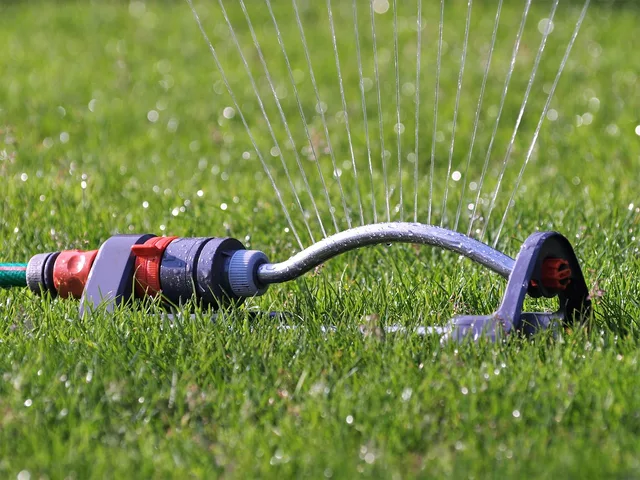
| Spray sprinkler body: Hunter Pro-Spray PRS40, Rain Bird 1800-PRS | High pressure, misting, uneven coverage; $6 to $12 each | Yes |
| Microirrigation kit: Rain Bird drip kit, Netafim Techline dripline | Spray wasted on beds, pots and shrubs; $30 to $80 | No label for this category |
| Leak or flow monitor: Moen Flo, Flume 2, Hunter Flow-Clik | Faults nobody notices for weeks; $200 to $850 | No label for this category |
| Rain or freeze sensor: Hunter Rain-Clik, Rain Bird WR2 | Cycles that run in the wrong weather; $60 to $150 | Usually none, sold as an accessory |
The unlabeled types that still earn their place
EPA's page on other water-efficient products is explicit that efficiency does not stop at the label, and it covers two categories relevant here.
Microirrigation is not labeled, yet the agency reports that such systems can use 20 to 50 percent less water than conventional sprinklers. A Rain Bird garden drip kit runs about $30 to $60, and Netafim's Techline dripline handles larger beds.
Leak detection and flow monitoring are unlabeled too. The page describes the two approaches on the market: moisture detection, which flags unexpected dampness, and flow monitoring, which watches consumption patterns for irregularities.
Flume 2, about $200, straps onto an existing meter with no plumbing cut. Moen Flo, typically $500 to $600 for the three-quarter inch version, mounts on the main line and shuts off the water when it finds a burst.
Phyn Plus runs about $850 plus installation and reads pressure waves in the pipe. Hunter's Flow-Clik, about $200 to $300, watches one irrigation zone. Both approaches are worth considering. Both simply lack the third-party evidence a label would give you.
Rain and freeze sensors stay unlabeled as well. The Hunter Rain-Clik, about $60 to $80, and the Rain Bird WR2 wireless sensor, about $100 to $150, interrupt a cycle in bad weather and wire into most controllers through standard terminals.
How to shortlist without a test bench
- Name the fault first. A leak monitor will not fix coverage, and a controller will not fix pressure.
- For labeled categories, filter on certification, then on zone count, sensor inputs, and offline behavior.
- For unlabeled categories, ask for the manufacturer's own test conditions and treat them as claims, not findings.
- Check that accessory sensors use standard terminals. The Soil-Clik and the Rain-Clik wire into the same ports as most controllers.
- Read the warranty for what covers labor rather than parts.
Where to start
If you are not sure which fault you have, run the diagnostic sequence in our planning guide first. Then use the broader map in our overview of smart yard technology to see how irrigation fits alongside lighting and machinery.
Buying in that order tends to remove one or two items from the shopping list entirely. A $15 hose-bib pressure gauge settles the pressure question in minutes, before any controller is bought.