Guides
Part of Reading smart yard technology with a sceptical eye, 2027 edition
Planning a smart yard setup: keeping room for expansion later
Plan a smart yard setup that survives expansion: site data first, pressure and pipe capacity, spare conduit and wire, and control that is not locked to one vendor.
Planning for later means leaving room, not buying more now. Spare wire in the trench you already opened. A valve manifold with an unused port. A controller with more zones than you use today.
Write site information down so the next contractor does not start from zero. Digging is the expensive part of a yard system. Digging twice is the mistake this article aims to prevent.
What to take away
- Record site data before you buy hardware, because soil, slope, and pressure decide what any device can achieve.
- Oversize the dull partsconduit, sleeving under paving, spare conductors, and valve capacity.
- Fix hydraulics before adding intelligence, since a controller cannot correct pressure or coverage faults.
- Prefer control that reads open inputs and exports its data, so a discontinued app does not strand the wiring.
Write down the site before you shop
Two numbers govern everything: static pressure at the hose bib and available flow in gallons per minute. A third, soil type, decides how fast water can enter the ground and how long a zone may run before it puddles. National soil mapping is free and unusually detailed.
Site data to record first
- Static pressure at the hose bib
- Available flow in gallons per minute
- Soil type and infiltration rate
- Meter, backflow device, valve boxes
- Sleeve crossings, tree roots, electrical panel
The USDA Natural Resources Conservation Service publishes Web Soil Survey. It gives the full soil survey report for an area you draw and lets you download spatial and tabular data. Information is refreshed annually.
It will not tell you what your builder buried in the backfill, but it is a defensible starting point for infiltration rate and drainage behavior.
Add a sketch: meter location, backflow device, existing valve boxes, sleeve crossings, tree roots, and where the electrical panel sits. Keep it as a file, not as a memory.
Fix the hydraulics first
High pressure does not water faster; it atomizes the spray. EPA's page on spray sprinkler bodies explains that systems running above the pressure a nozzle needs produce misting, fogging, excess flow, and uneven coverage.
Pressure regulation savings
- 50,500gallons used outdoors by average household
- 60psi threshold in the worked example
- 5,600gallons saved per year with labeled bodies
- 60dollars saved per year
Labeled bodies use integral pressure regulation to keep constant flow at the nozzle. The specification references the consensus ASABE/ICC 802 standard.
It gives a worked example: for an average household using 50,500 gallons outdoors at or above 60 psi, labeled bodies can save nearly 5,600 gallons and about $60 a year. Regulation at the body is cheap compared with re-piping later.
Leave room in the boring parts
Element / Today's need
- Control wire
- Four zones · Multi-conductor with at least two spare wires
- Conduit under paving
- One crossing · A sealed sleeve one size larger, capped at both ends
- Valve manifold
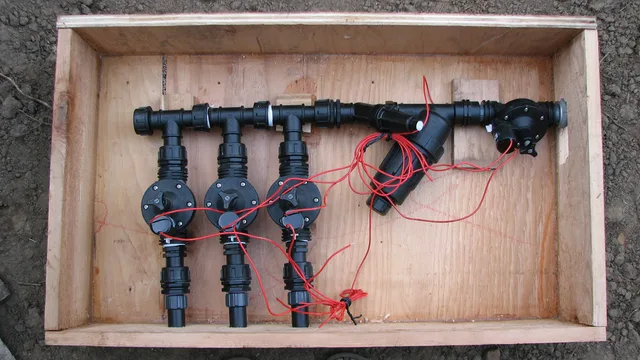
- Three valves · Manifold with one unused port
- Controller
- Four stations · A model that expands, with sensor inputs you can actually reach
- Power
- One transformer · A weatherproof outlet on its own circuit
None of that is glamorous, and all of it is cheaper while the trench is open.
Keep the control layer replaceable
Ask whether the controller accepts a standard rain or freeze sensor input, whether schedules can be set locally when the network is down, and whether you can export run-time and flow history.
A device that only speaks to one cloud account is replaced entirely when the service changes. With a shortlist in hand, work through how to read the published specifications rather than the marketing page. Keep the staged approach in our overview of the category.