Industry
What genuine smart yard case studies teach, once the marketing is stripped out
What published project documentation teaches about smart yards: which claims are checkable, what a real case study contains, and how to use one honestly.
A case study is only useful if you can tell what was measured. Most material published under that name in the yard technology market is a customer story with a percentage attached.
Documented projects from public programs differ: they name the site, describe the intervention, state the method, and publish figures somebody could challenge. This article explains the difference and how to use it.
What to take away
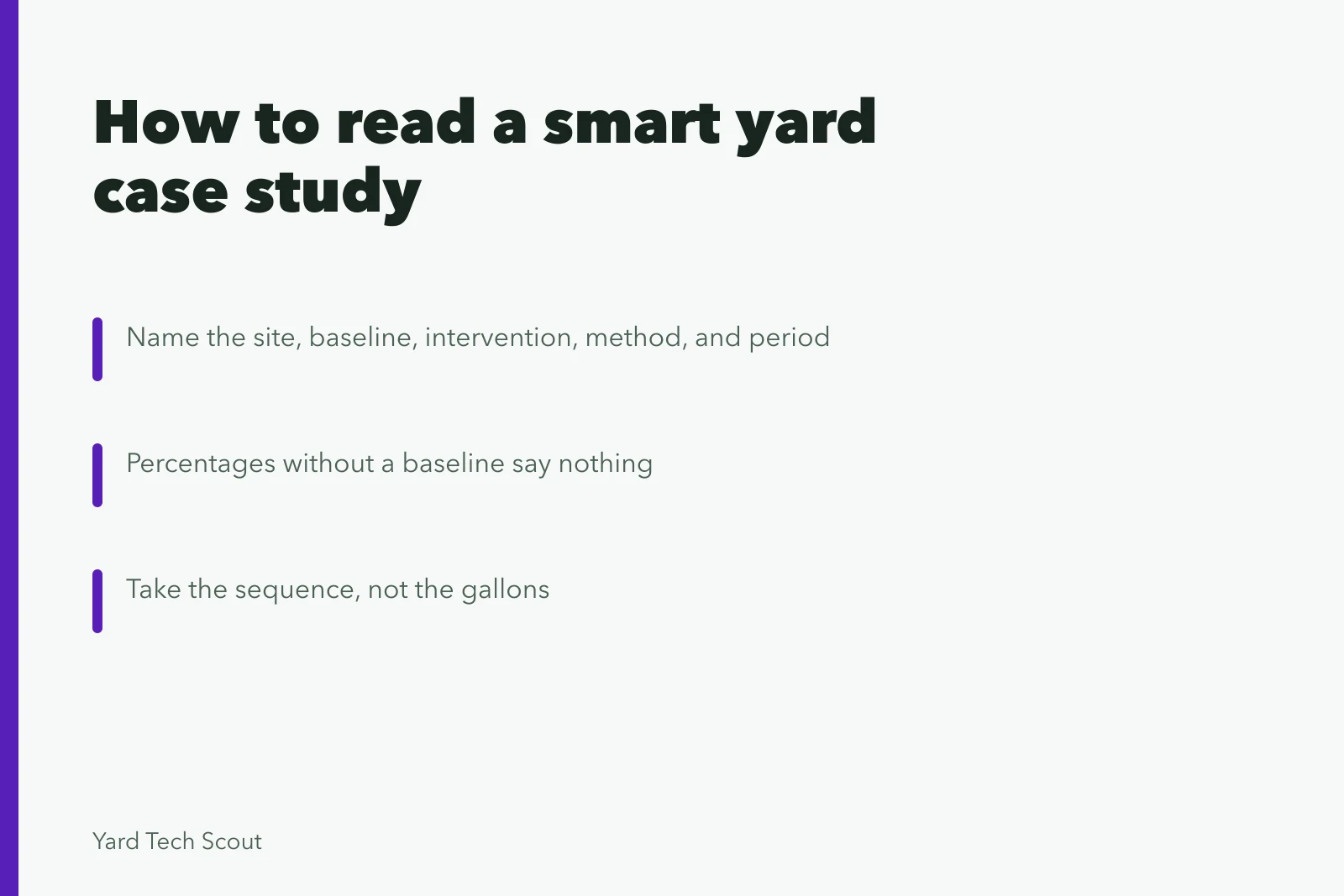
- A usable case study names the site, the intervention, the measurement method, and the period.
- Percentages without a baseline are the most common way a case study says nothing.
- Public programs publish the strongest documentation, and it is mostly about communities rather than gardens.
- Read case studies for method and sequence, not for numbers you can transfer to your own yard.
What a documented approach looks like
Public water work has a well-defined structure. EPA's description of the watershed approach lists its components. It is hydrologically defined, geographically focused, community based, and covers all stressors while involving all stakeholders across public and private sectors.
Watershed Approach Attributes
- Hydrologically defined
- Geographically focused
- Community based
- Covers all stressors
- Involves all stakeholders
- Integrates regulatory and voluntary programs
- Uses adaptive management
It targets priority goals such as water quality and habitat, integrates regulatory and voluntary programs, rests on sound science, is aided by written plans, and uses adaptive management. Nine attributes, each checkable against a document.
Compare that with a product page claiming a customer saved a third of their water. One of those two can be interrogated.
Scale and tracking
Serious programs publish what they track, and EPA's national water reuse action plan is a framework built with water-sector partners. Since 2020 it has grown to more than 96 actions with 215 action leaders and partners, including a federal interagency working group. A second version was released in April 2026.
Water Reuse Action Plan Scale
- 96+actions
- 215action leaders and partners
- 2020plan launched
- April 2026second version released
Whatever you think of the subject, the form is instructive: named actions, named owners, and a public record of what changed.
Reading any case study
Present in a strong case study
- Site
- Named, with location and type
- Baseline
- Metered, over a stated period
- Intervention
- Described in enough detail to repeat
- Method
- How the result was measured
- Confounders
- What else changed
- Cost
- Stated, with what it included
Warning sign
- Site
- "A customer in the southwest"
- Baseline
- A percentage with no starting point
- Intervention
- A product name
- Method
- Not mentioned
- Confounders
- Not mentioned
- Cost
- Omitted, or given as a range
What to do with one
Take the sequence, not the number. If a project audited, repaired, metered, and only then automated, that ordering is transferable to almost any property. The gallons are not. Your climate, soil, plants, water rate, and starting condition are all different, and any one of them can be larger than the effect being reported.
Write down the steps a case study describes, strike out every figure, and see whether what remains still tells you what to do next. In good documentation it does.
Read documented outcomes alongside our note on what owners report, which explains where anecdote takes over. Read our summary of lessons from projects that went wrong because failures are documented far less often than successes.