Guides
Part of Getting outdoor lighting controls right the first time, updated for 2027
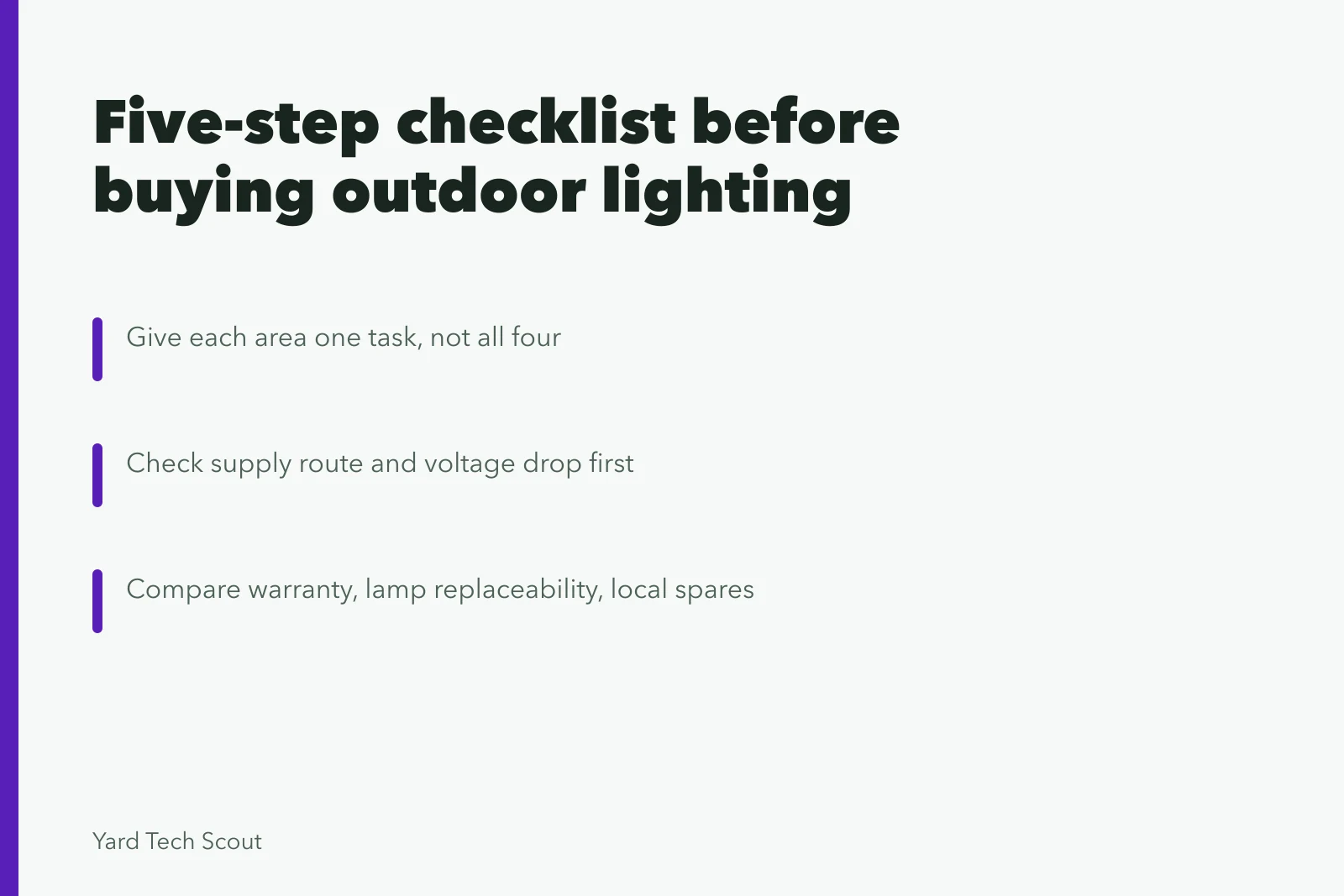
Before buying outdoor lighting gear, run this five-step checklist
A checklist for buying outdoor lighting controls: name the task per area, check the electrical route, plan spill and habitat, then compare control and service terms.
Lighting purchases go wrong when the buyer starts with fixtures. Start instead with a task for each area, because the task determines the control method, the control method determines the wiring, and the wiring determines most of the cost. This checklist runs in that order and can be worked through in an evening with a notepad.
What to take away
- Give every area one tasksafe movement, security, use of a space, or appearance. Not all four.
- Check the electrical route before choosing anything, since the supply is the expensive part.
- Decide where light must not fall, and shield for it at purchase rather than afterwards.
- Compare warranty, lamp replaceability, and local spares alongside the control features.
Stage one: one task per area
| Area | Likely task | Control that fits |
|---|---|---|
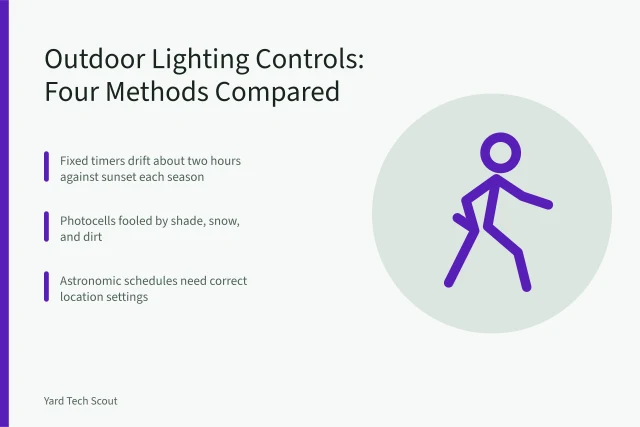
| Steps and level changes | Safe movement | Astronomic schedule, low output |
| Entrance and gate | Recognition and security | Motion with a short timeout |
| Seating or dining area | Use of the space | Manual or scene, with an off time |
| Specimen planting or facade | Appearance | Schedule with an early off time |
| Boundary or side passage | Deterrence, occasionally | Motion, shielded, aimed inward |
If an area gets two tasks, it usually needs two circuits or two settings, not one brighter fixture.
Area, Task, Control Fit
Area
- Steps and level changes
- Safe movement
- Entrance and gate
- Recognition and security
- Seating or dining area
- Use of the space
- Specimen planting or facade
- Appearance
- Boundary or side passage
- Deterrence, occasionally
Likely task
- Steps and level changes
- Astronomic schedule, low output
- Entrance and gate
- Motion with short timeout
- Seating or dining area
- Manual or scene, off time
- Specimen planting or facade
- Schedule with early off time
- Boundary or side passage
- Motion, shielded, aimed inward
Control that fits
- Steps and level changes
- Entrance and gate
- Seating or dining area
- Specimen planting or facade
- Boundary or side passage
Stage two: check the electrical route
Where is the nearest suitable supply, is it protected, and does a new circuit need a permit? How far is the transformer from the furthest fixture, and what does that do to voltage drop? Where would the cable cross paving, roots, or a drainage feature? Answer these before shortlisting, because they set the budget.
Electrical Route Checks
- Nearest suitable supply identified
- Supply protection confirmed
- New circuit permit needed?
- Transformer distance to furthest fixture
- Voltage drop calculated
- Cable crossingspaving, roots, drainage
Stage three: decide where light must not fall
Spill onto neighboring property, onto a road, and onto habitat is a design choice. Where you have planted for pollinators or maintain any wildlife area, aim and shield deliberately.
Pesticide decisions in the same yard carry their own protections. EPA's summary of actions to protect pollinators describes measures from its review of the neonicotinoid group.
They include management measures to keep pesticides on the intended target and cut amounts used, limits on spraying blooming crops to reduce bee exposure, and label wording for homeowners. Lighting and spraying decisions share the same ground, so make them together.
Stage four: plan for the hours you will actually be outside
Lighting an area for evening use means using it when biting insects are active, which is a health question, not just an annoyance. EPA's page on the risk of disease from mosquito and tick bites lists diseases carried by mosquitoes, including West Nile virus, dengue, and malaria, and by ticks, including Lyme disease and Rocky Mountain spotted fever.
It directs readers to their state or local health department and cooperative extension office for information about insect control in their area. Plan seating areas, screening, and repellent use with that in mind, and follow product labels.
Stage five: commercial terms
Warranty length and whether it covers labor. Whether lamps are replaceable or the fixture is sealed. Whether spares will exist in five years. Whether the controller keeps a schedule without a network. Then work through the wider questions in our checklist for automation projects, and choose the control method using our comparison of lighting controls.