Guides
Robotic Lawn Mower for Steep Slopes: What to Look For
A robotic lawn mower for steep slopes needs the right grade rating and traction. Compare traction, navigation and stated grade before buying.
What to take away
- A published slope rating describes dry turf on a test ramp, so treat it as a ceiling rather than a target.
- Degrees and percent grade use different scales20 degrees is about a 36 percent grade, and 30 degrees is about 58 percent.
- Traction, not software, decides whether a wheeled mower holds a grade above 20 degrees, which is common in parts of West Virginia and Colorado.
- Nothing in this class mows the band above its own rating, so the steepest strip stays hand work.
What a slope rating actually measures
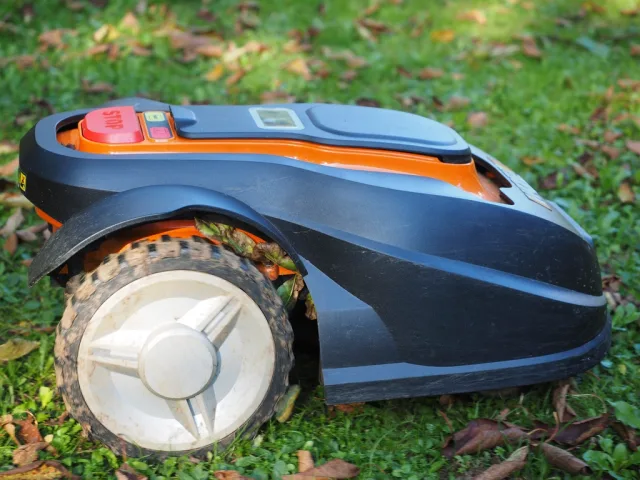
A robotic mower is a battery, three pivoting blades, and either a buried boundary wire or a satellite receiver. That layout has barely changed in a decade, as the overview of robotic lawn mowers sets out. What has changed is how steep a machine claims to handle.
Grade vs Degrees
- 20 degreesabout 36 percent grade
- 30 degreesabout 58 percent grade
- 45 percentgentler than 30 degrees
A rating in percent is rise divided by run, then multiplied by 100. Twenty degrees equals roughly a 36 percent grade. Thirty degrees is close to 58 percent. A listing that says 45 percent describes a gentler hill than one that says 30 degrees, even though the second figure reads as smaller.
Manufacturers measure that number on a smooth ramp with dry turf and fresh tread. The figure answers one narrow question: can the machine climb this once? It says nothing about holding a straight line or turning at the crest.
Which machines are sold for slopes
Search demand for Husqvarna Automower steep slope models runs high. The all-wheel-drive Automower units are the ones marketed for graded ground, and other brands sell tracked and wire-free machines with similar claims.
This guide does not rank individual models, because ratings change with each product year; it shows how to read the rating on whichever model you shortlist. Some makers state two slope figures, one for inside the cutting area and a lower one at the boundary. The boundary figure is the one buyers miss: a bank that runs right up to the edge of the lawn is limited by it, not by the headline number.
Compare the stated grade rather than the badge. A unit rated to 24 degrees will not hold a 30 degree bank, whatever the product page suggests. Read every model's rating the same way: which figure applies inside the area, which at the boundary, and whether the number is in percent or degrees. Cold-weather limits decide winter storage and battery life for many US buyers, and those are gathered in Robotic Lawn Mower for Canada.
How the three approaches compare
Three hardware choices reach US buyers with graded ground. They differ on traction before they differ on anything else.
All-wheel drive, boundary wire
- Typical stated grade
- about 20 to 27 degrees
- Wet turf grip
- good while tread is clean
- Navigation
- wire loop, works under canopy
- At the crest
- slows, may slip
- Turf damage
- low
- Illustrative price band
- $1,500 to $4,000
Tracked crawler, boundary wire
- Typical stated grade
- about 25 to 35 degrees
- Wet turf grip
- strong, tears turf on turns
- Navigation
- wire loop
- At the crest
- holds better
- Turf damage
- ruts on soft ground
- Illustrative price band
- $1,800 to $5,000
Wire-free RTK, all-wheel drive
- Typical stated grade
- about 20 to 25 degrees
- Wet turf grip
- matches wheeled
- Navigation
- needs clear sky view
- At the crest
- can lose its fix
- Turf damage
- low
- Illustrative price band
- $2,500 to $6,000
Those bands are illustrative, not quotes.
Where each one is the right answer
An all-wheel-drive wheeled mower on a boundary wire suits a lawn of 15 to 24 degrees under mature trees. Boundary wire ignores canopy, and four driven wheels grip better than two.
A tracked crawler suits an open bank steeper than 25 degrees with a firm base, plus rough ground where ruts do not matter. Check the soil first: the USDA SSURGO soil survey flags clay-heavy areas where tracks cut deep grooves.
A wire-free RTK mower suits a 20 to 25 degree lawn with open sky and a boundary you redraw each season. Avoid it where a house or a tree line blocks the southern sky. Where the wire and the dock sit decides how often the unit stalls, and that pattern is traced in yard technology installations.
The limit none of them solve
Every option here stops where traction stops. A grade above the stated ceiling is not a setting you can push. The machine slips, stalls, or gouges turf at each turn. Neither firmware nor a larger battery moves that ceiling.
Two gaps are shared: each machine leaves an uncut band of several inches along walls and under shrubs. Each needs a dry surface for its steepest passes.
A slope that sheds water after rain gets mowed less often than the flat lawn below. Runoff also decides how the slope gets watered, and the controller comparison in Rachio vs RainMachine covers cycle and soak scheduling.
A slope rating tells you what the mower climbed once, in ideal conditions. It does not tell you what it will hold in June, after three days of rain.
Site checks before you buy
- Measure the grade over a ten foot run with a straightedge and a level, then convert the rise into percent and degrees.
- Repeat the walk after rain, since soft ground is the honest test and the condition that voids most performance claims.
- Map the sky within thirty feet of the route, including canopy, walls and metal sheds, because a satellite fix fails there.
- Confirm a weather-protected outdoor outlet for the dock, and check the covenants, since approval for exterior equipment follows the review described in HOA Rules for Smart Outdoor Lighting.
- Decide who mows the strip above the rating, because that band stays yours either way.