Rules
Part of Getting outdoor lighting controls right the first time, updated for 2027
4 things to understand about outdoor lighting controls
Which rules reach outdoor lighting: electrical permits, nuisance and spill ordinances, association covenants, and state rules where treatments accompany lighting.
Outdoor lighting is regulated in more ways than most buyers expect. Almost none of it is national.
Electrical work follows adopted code and local inspection. Spill and glare fall under nuisance provisions, zoning conditions, or dedicated ordinances. Appearance falls under covenants. Lighting paired with insect treatment draws a second set of rules.
This is not legal advice. It is a map of who to ask.
What to take away
- Any new line-voltage circuit usually needs a permit and an inspection. Low-voltage rules vary widely.
- Spill and glare complaints are usually handled under nuisance or zoning provisions rather than a lighting code.
- Covenants can regulate fixture style, color temperature, mounting height, and hours.
- If lighting is paired with insect treatment, the label and state pesticide rules govern that part.
The four bodies to ask
Four bodies, four questions
Building department
- Controls
- Permits, circuits, inspections
- Ask before
- New supply or panel work
Zoning or code enforcement
- Controls
- Spill, glare, brightness
- Ask before
- Aiming toward a boundary
Association or landlord
- Controls
- Style, color, height, hours
- Ask before
- Purchase, in writing
State pesticide agency
- Controls
- Treatments in same area
- Ask before
- Any spraying or misting
| Body | Typically controls | Ask before |
|---|---|---|
| Building department | Permits, circuits, inspections, fixture mounting | Any new supply or panel work |
| Zoning or code enforcement | Spill, glare, brightness near boundaries | Aiming anything toward a boundary |
| Association or landlord | Style, color, height, hours, common areas | Purchase, in writing |
| State pesticide agency | Treatments applied in the same area | Any spraying or misting arrangement |
Where the local documents usually live
Local requirements are documented, but finding them takes a specific search, not a general one. Watershed programs show how it is organized.
EPA's resources for watershed planning collects a national handbook on watershed plans for communities and watershed organizations, plus guidance for state, local, tribal, and federal agencies. Supplements address identifying critical source areas and estimating nutrient and sediment losses.
The subject is water rather than light, but the pattern is the one to copy: a national framework document, then a state or local plan that says what applies where you live. Ask your municipality for the ordinance by name rather than asking whether lighting is regulated.
When the treatment comes with the lighting
Households lighting a yard for evening use often add mosquito control. That part is regulated. EPA's page on pesticides used to control adult mosquitoes explains that state and local agencies apply adulticides as ultra-low volume sprays from aircraft or truck-mounted sprayers.
Quantities are very small relative to the treated area, and applied according to the label, they can be used in public health programs without posing risks of concern.
That describes organized public programs, not a homeowner with a device. For anything on your own property, the label is the law and your state pesticide agency is the authority. Never assume a treatment permitted for a mosquito control district is permitted for a private yard.
Practical order of operations
Ask the building department about the circuit and whether an inspection is required. Ask code enforcement about boundary spill and any brightness limit near a road.
Ask the association for written approval of style, height, and hours and ask the state agency about any treatment you intend to apply. Then buy, and keep every answer with a date and name attached.
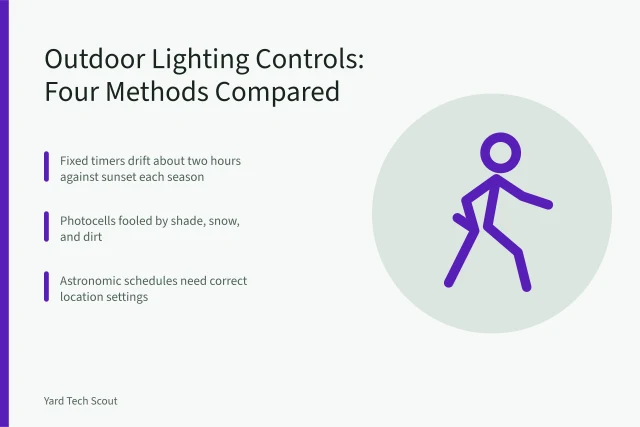
Compare how the same bodies behave for other yard work in our note on building and local rules, and choose the control method with our comparison of lighting controls.