Guides
Part of What genuine smart yard case studies teach, once the marketing is stripped out
Documenting a yard project: the record that lets results be checked later
How to document a yard project properly: set a baseline, record the intervention and the site factors, note confounders, and publish figures that can be checked.
Documenting a project properly costs about two hours spread across a season. It turns your own experience into something you can rely on later.
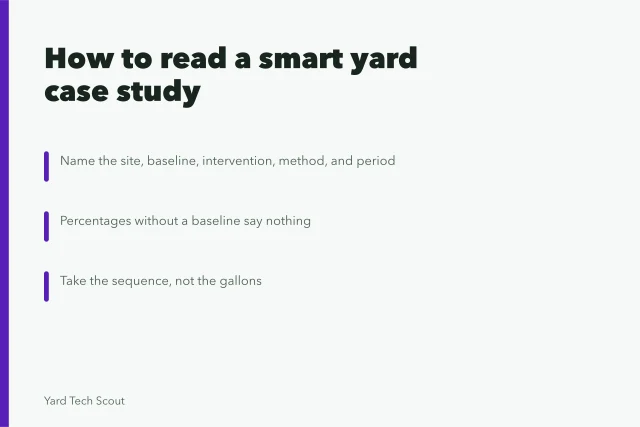
Without it, next spring you will reconstruct what you did from memory. Any claim about the result will be an impression. Keep this record; published projects use this structure.
What to take away
- The baseline is the whole exercise. Without a metered starting point there is nothing to compare.
- Record the site as well as the intervention, because site factors explain most differences between projects.
- Write down what else changed, honestly, including the weather and anything you did by hand.
- Keep it in one place that survives a phone upgrade and a change of contractor.
The record, in five parts
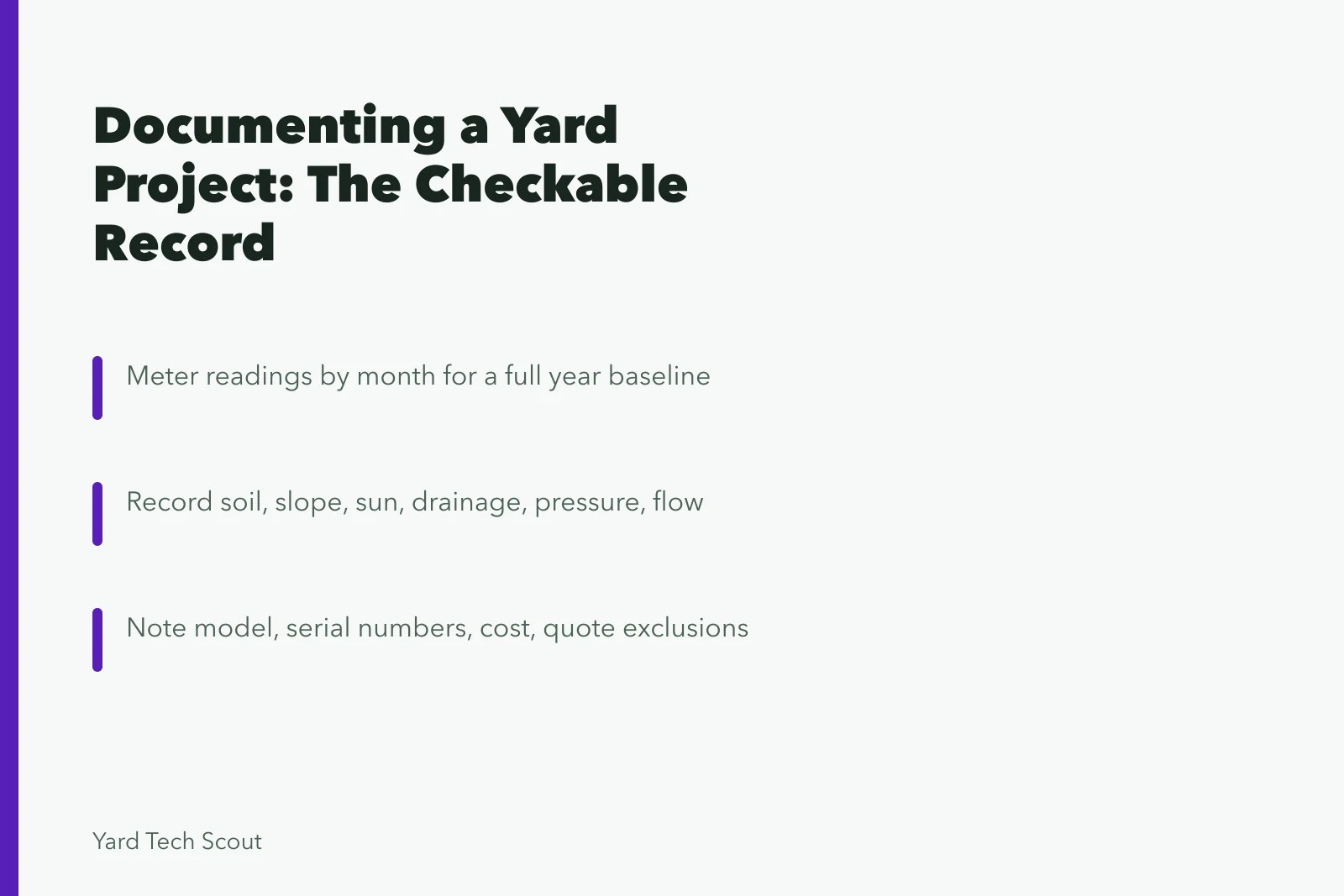
- Baseline.Meter readings by month for a full year if you have them, and at minimum for the same months last year. Photographs, dated. The existing schedule and settings.
- Site.Soil, slope, sun and shade, drainage behavior in a real storm, pressure and flow readings, and anything buried.
- Intervention.What was installed or changed, model and serial numbers, who did it, what it cost, and what the quote excluded.
- Result.Meter readings for the same months after, plus observations of plant condition and any faults.
- Confounders.Rainfall against the seasonal norm, a new lawn or new planting, extended absences or extra household members, a leak found and fixed, and any change in the water rate or tariff structure.
Structures worth copying
Communities publishing this kind of material have converged on a shape. EPA's page on decentralized wastewater demonstration projects and case studies describes an investment of over $35 million across more than 25 states. The projects cover environmental assessment, performance requirements, system design, installation, operation, maintenance, and monitoring.
Five management models
- Homeowner awareness
- Maintenance contracts
- Operating permits
- Management-entity operation
- Management-entity ownership
Community case studies were compiled into a compendium and grouped into five management models, from homeowner awareness through maintenance contracts and operating permits to management-entity operation and ownership. Notice what is being documented: not only the technology, but who is responsible for it afterwards. That is the part most private records omit entirely.
Record the site factors that explain the result
Design documentation usually lists the site conditions considered, and that list is worth borrowing. EPA's discussion of green infrastructure and groundwater explains that infiltrating practices let stormwater soak into surrounding soil, where additional pollutant removal may occur, promoting recharge.
The bottom of such a practice should be adequately separated from the water table to aid infiltration and maximize pollutant removal. Recharge is often desirable in arid regions but can introduce pollutants if not done properly.
Depth to water table, soil type, and separation distance are exactly the kind of site facts that explain why the same design behaves differently on two properties.
Publishing, if you choose to
Publishing attaches your address to figures about your household and photographs of it. Decide deliberately, not by default, and check with anyone else who lives there.
If you do publish, state the method, give the baseline, and name the confounders, then test the result first with our proving a system works guide. Judge your write-up against our guide to reading case studies.