Guides
Part of 4 Pointers for Robotic Yard Equipment on Lawns
An honest review of robotic yard equipment
Robotic mowers, their real strengths and limits, and the site measurements and lawn slope data that decide whether any of them suits your yard.
Most regret about robotic yard equipment traces back to a measurement nobody took. Area is the number buyers quote and the least useful one. Slope, passage width, obstacle height, and surface transitions decide whether a machine works at all. Below is what six widely sold machines actually do, what they cost, and where each one fails.
Owner accounts here come from public forums and retailer reviews, not a lab test.
What to take away
- Husqvarna Automower and STIHL iMow use boundary wireproven, cheap to install, and you must bury or peg the loop before the first cut.
- Mammotion Luba and Ecovacs Goat rely on RTK satellite positioning: no wire, but tree cover and tall walls degrade the fix.
- Worx Landroid and Segway Navimow sit in the middle on price and capability, typically $1,000 to $2,500.
- Measure the steepest slope and the narrowest gap before comparing any specification sheet.
- Confirm the local dealer stocks blades and wheels, because a machine waiting on a part is a lawn growing.
- Small flat lawnsSegway Navimow i105N or Ecovacs Goat GX-600, both wire-free.
- Sloped groundMammotion Luba 2 AWD 5000, or a wired Husqvarna 450X NERA where the slope is uneven.
- Tree cover and tall wallsa wire machine, so Husqvarna Automower or STIHL iMow.
- Separate lawnsa wire machine with a second loop, or a model whose manual confirms multi-zone routing from one base.
- Mixed yard, one machineSegway Navimow H800E, wire-free and typically $1,300 to $1,600.
What the six cost
| Model | Boundary | Rated area | Typical price |
|---|---|---|---|
| Husqvarna Automower 115H | Wire | Small yard class | $1,400 to $1,700 |
| Husqvarna Automower 450X NERA | Wire | Up to 1.25 acres | $4,000 to $5,000 |
| STIHL iMow 422 P | Wire | Smaller lawns | $1,800 to $2,300 |
| STIHL iMow 632 P | Wire | About 1 acre | $3,200 to $3,800 |
| Mammotion Luba 2 AWD 5000 | RTK | About 1.25 acres | $1,600 to $2,200 |
| Mammotion Luba 2 AWD 10000 | RTK | Larger lawns | Near $3,000 |
| Ecovacs Goat G1 2000 | RTK and vision | About 0.5 acre | $1,100 to $1,600 |
| Ecovacs Goat GX-600 | Vision only | About 600 square meters | $700 to $1,000 |
| Worx Landroid WR155 | Wire | About 0.37 acre | $1,400 to $1,700 |
| Worx Landroid Vision L1300 | Vision | About 1,300 square meters | $2,000 to $2,500 |
| Segway Navimow H800E | RTK | About 800 square meters | $1,300 to $1,600 |
| Segway Navimow i105N | RTK | Small yard class | Near $1,000 |
Prices are typical US retail for the machine as equipped. Blades, wear parts, and any data plan come on top.
The wire machines: Husqvarna Automower and STIHL iMow
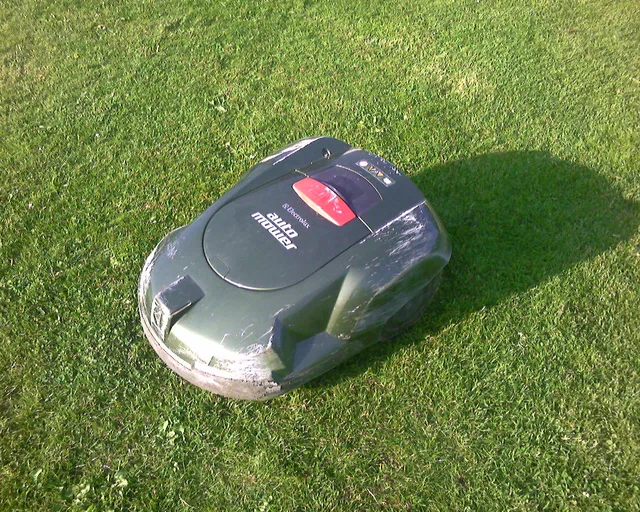
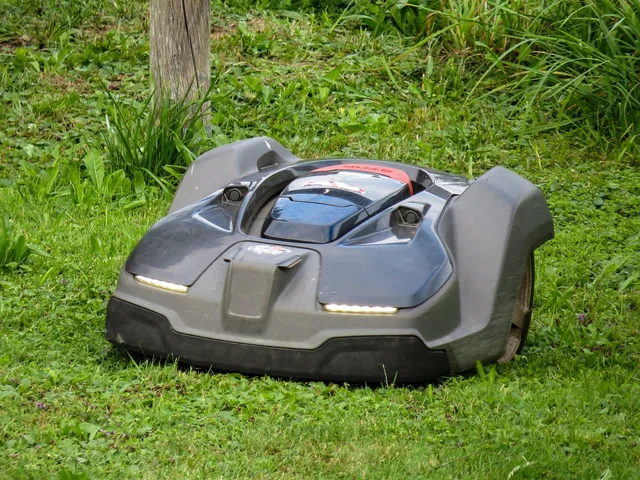
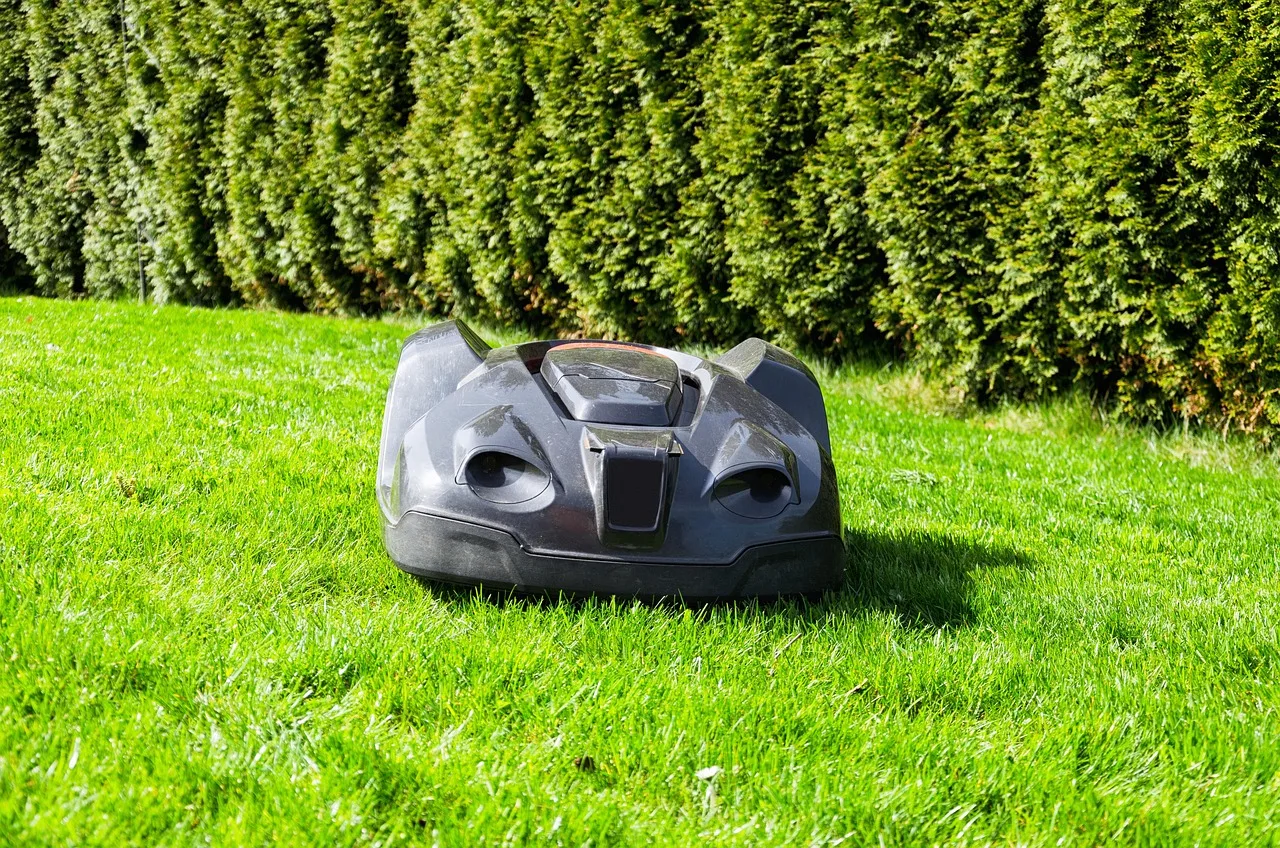
Husqvarna's Automower line is the reference point for boundary wire. The loop carries a low-voltage signal, the machine stays inside it, and the system keeps working under tree canopy where satellite units struggle. The Automower 450X NERA is rated for lawns up to 1.25 acres and slopes up to about 45 percent.
Husqvarna publishes specs by working area, slope limit, and cutting width. The 415X covers about 0.37 acre. The 115H suits small yards.
Owner reports on this line repeat one pattern: the machine rarely fails, cut loop wire does, and a dealer with blades in stock turns repairs around in days.
STIHL's iMow range works the same way and shares the dealer network that services STIHL's other outdoor equipment. The iMow 632 P is rated for lawns up to about 4,300 square meters, just over an acre. The smaller 422 P covers less ground.
iMow owners tend to praise dealer support and fault the app for slow schedule and map edits.
Both brands sell through dealers rather than direct, so service and spares are a phone call rather than a shipment. The trade-off is the wire itself, because it has to be laid around every bed and island.
A spade through the loop during later planting stops the machine until you splice it. If your beds will change, that is a recurring cost.
The wire-free machines: Mammotion Luba and Ecovacs Goat
Mammotion's Luba uses RTK positioning, a base station that corrects satellite drift to centimeters. No loop to bury. Mammotion rates the Luba 2 AWD 5000 for up to 5,000 square meters, about 1.25 acres, with all-wheel drive for steep ground.
It suits open lawns with clear sky and struggles where a building or mature tree blocks the correction signal.
Luba owners most often report first-season docking faults at the RTK station, cleared later by firmware, and strong grip on wet slopes.
Ecovacs' Goat line takes a similar approach and adds vision for obstacle handling. The Goat G1 2000 covers about 2,000 square meters, half an acre. The vision-only GX-600 skips RTK and covers roughly 600 square meters.
Goat owners report the vision system improving with firmware but still stopping for hoses, low branches, and dark patches.
Vision systems improve every year, but they still misread a hose or a low branch. Ask the dealer what the machine does when it loses its position fix, because the answer differs by model.
Wire-free installs are faster. They are also more sensitive to the site, which is why the measurement stage below comes before the purchase, not after.
The $1,000 to $2,500 bracket: Worx Landroid and Segway Navimow
Worx Landroid uses a boundary wire and sells at a lower price than the Swedish and German brands. The WR155 handles up to 1,500 square meters, about 0.37 acre. It suits a straightforward lawn with few obstacles.
Landroid owners report reliable cutting and an app that lags, with map and schedule edits the usual gripe.
Segway's Navimow uses RTK without a wire and targets the same buyer. The H800E covers about 800 square meters, and the i105N is the entry model.
Navimow owners report fast setup and occasional map drift that clears after a re-mow or a firmware update.
Both are sold through consumer retail, so support runs through the retailer rather than a dedicated dealer. Check the warranty terms and who handles the repair before you buy. Worx also sells the wire-free Landroid Vision L1300, a camera-guided model rated for about 1,300 square meters.
Measure before you compare
- Total area, and each separate area if they are not connected by a mowable route.
- Steepest slope, measured rather than judged, including short banks.
- Narrowest passage between beds, walls, or trees.
- Height of every step, curb, and root crossing.
- Softest ground after rain, since that is where a machine bogs down.
Mark irrigation valve boxes, utility covers, shallow cabling, and any onsite wastewater system before choosing a base position. The USDA Natural Resources Conservation Service's Working Lands for Wildlife makes the same case for leaving some ground uncut.
Returned clippings are usually a benefit. EPA's explanation of the types of nonpoint source pollution sets out how rainfall and snowmelt carry pollutants into surface water. Keep clippings on the grass, and sweep rather than hose anything that escapes.
Battery, app, and subscription costs
Runtime is quoted as cutting time per charge. It depends on battery size, grass height, and climbing. Most robots dock on a low battery and resume after charging, so compare minutes of cutting against recharge time.
Typical owner reports put the first battery replacement at two to four seasons. Cut wire or a dock fault usually comes earlier.
App quality separates these machines more than the hardware does. Ask to see the app before you buy, and check how long a map edit takes and whether the machine runs without a cloud account.
Firmware arrives over Wi-Fi and can change boundary behavior, so ask how updates are delivered. RTK models need a base station or a correction service, and terms vary. Get the term, the renewal price, and what happens when the service lapses in writing.
What to confirm before signing
| Item | What to confirm |
|---|---|
| Model fit | Working-area rating, slope limit, and cutting width of the exact model, not the brand |
| Safety features | Lift and tilt sensors, blade stop behavior, child and pet guidance |
| Boundary method | Wire, satellite, vision, or a mix, and what happens when it fails |
| Price class | Purchase price as equipped, plus blades and any data plan |
| Rain behavior | Does it shelter, and does it resume automatically |
| Noise rating | Stated level and the hours you plan to run |
| Service | Where, how long, and whether a loan machine exists |
| Spares | Blades and wheels stocked locally, and for how many years |
| Security | PIN, alarm, tracking, and what your insurer expects |
If the machine fails a site constraint, no feature list rescues it. Compare the result against the wider approach in our checklist for automation projects.
Common questions
Does lawn area really not matter?
It sets the size class. It just does not predict whether the machine can reach every part of your yard.
Wire or wireless boundary?
Wire is proven and inflexible. Satellite and vision systems adapt more easily and depend on conditions such as tree cover. Ask what happens on a bad signal day.
Can one machine cover two separate lawns?
Sometimes, with a transport mode or a second base. Confirm before assuming, and check whether the model supports multi-zone routing without a second base.
What about very small lawns?
Below a certain size the machine costs more than the time it saves. A cordless push mower may simply be the better tool.