Guides
Part of What genuine smart yard case studies teach, once the marketing is stripped out
Documented yard installations: the sequence real projects actually follow
The installation sequence that documented projects follow: business case, planning, metering, leak repair, then installation, verification and continued monitoring.
Published projects follow a sequence consumer installations rarely do. The order is the interesting part. The first work in a documented project is almost never hardware. It is the case for doing anything, then the plan, then measurement, then repair.
Installation appears late, and monitoring continues afterwards. This article sets out that sequence and how to run it on a domestic scale.
What to take away
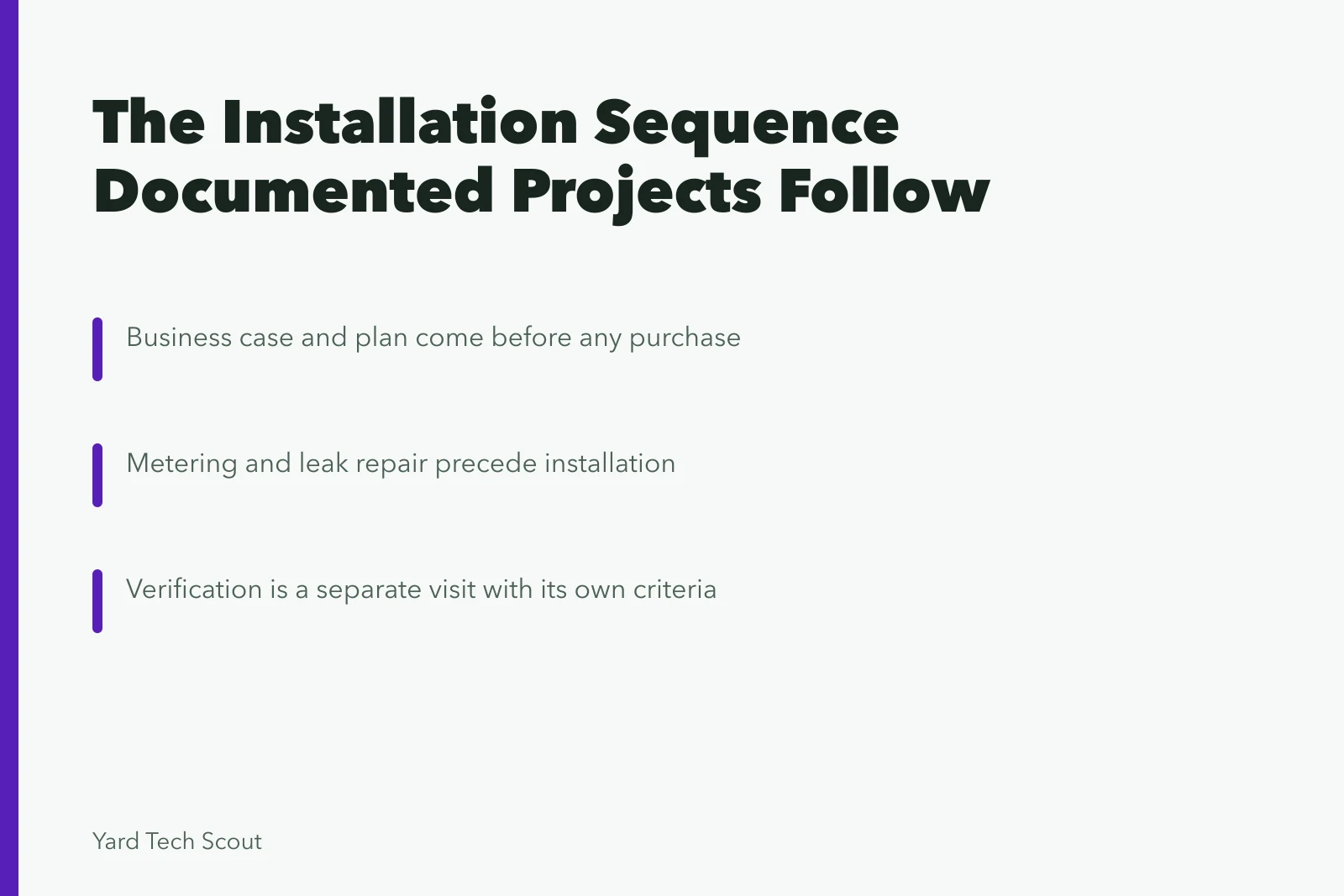
- Documented projects put the business case and the plan before any purchase.
- Metering and leak repair come before installation, not after, because they change what needs installing.
- Verification is a distinct step with its own criteria, separate from the installer saying it is finished.
- Monitoring continues after handover, which is what makes a later claim about the result possible.
The sequence, as programs describe it
EPA's guidance for facilities on getting started with water management gives this order: make the business case, plan, meter, then address leaks. It notes water and wastewater costs have risen well above the consumer price index over recent decades.
Water management sequence
- Make the business case
- Write the plan
- Meter water use
- Address leaks
- Choose equipment
Facility managers should expect continued increases as aging supply systems are replaced. That argument gets a project approved. Only after those steps does the material turn to specific equipment and practices.
Translate that to a house. Work out what you are trying to fix and what it is costing, write a plan, read your meter for a season, fix the leaks you find, and then decide what to buy.
Where implementation support fits
Documented projects rarely rely on one person knowing everything, and they say so. EPA's page on capacity-building resources defines capacity building as establishing the resources needed to achieve a goal.
It lists what groups actually need: technical tools for scientific and engineering support, information technology, help with legal issues, project management, and outreach and planning support, alongside the legal authority to permit, contract, and manage resources. The equivalent at household scale is knowing which parts you will do, which parts need a licensed trade, and who signs off the result.
The domestic version, step by step
| Step | What it produces | Do not skip because |
|---|---|---|
| Case | A written problem and its cost | Without it, scope creeps forever |
| Plan | Zones, sequence, budget by category | It is what makes quotes comparable |
| Meter | A baseline in gallons | Nothing can be proven later without it |
| Repair | An itemized fault list, closed out | Automation multiplies unrepaired faults |
| Install | The physical work | It is the visible part, not the important one |
| Verify | Coverage, pressure, and schedule checked | Handover is not the same as working |
| Monitor | Readings and a maintenance log | Drift is silent and constant |
Verification deserves its own visit
Verification means running every zone, measuring output and evenness, reading pressure at the far end, and confirming the schedule matches the agreed plan. Do this on a different day than installation, when the crew is not waiting.
Compare the scope side in our note on what installation involves. Hold the whole record to the standard in our guide to reading case studies.